Today’s ✨ free marketing idea ✨ is sponsored by Ahrefs
You know that moment when someone asks “wHy Is TrAfFiC dOwN? “ and finding the answer will cost you a full day in spreadsheets? I hate that.
Letaido, Ahrefs’ new AI tool, will change your life. You ask the chatbot anything, and it runs an analysis using Ahrefs’ live data: the “why” behind the traffic drop, plus the exact steps out of it. Then it builds reports, dashboards, trackers, even full apps.
Ahrefs’ CMO tested it on a brutal case: ClickUp’s blog lost 97.6% of its traffic. The chatbot came back with the same conclusions as a human SEO expert.
I tried it and it’s 10x smarter with marketing data than any general AI.
» Sponsor the newsletter to reach 95,220 marketers «
Funny Marketing 101
Is there anything more cringe than a company trying to be funny and failing?
That’s the kind of #FAIL that people don’t laugh at.
I understand why marketers try so hard to make it work. When you make someone laugh, they remember you, and they forward you to people you could never reach with an ad. It changes buying too: 72% of people say they’d pick a funny brand over a serious competitor.
But in case you haven’t noticed: It’s really freakin’ hard to be funny. Especially in a work context. Especially if you want something to be repeatable.
I hate to break it to you, but AI isn’t funny 🙇♀️
Humor is one of the few areas where AI isn’t helping out. Maybe we’ll get genius-level funny LLM in the future, but right now? Not really.
It’s not because LLMs have trouble figuring out the nuances of what makes us laugh. It actually has to do with why humor is so effective in the first place:
The real power of humor is connection. It’s to make people feel like, “they get me.”
When a brand makes me laugh at something only my people would understand, it stops being “them” and “me” and becomes “us.” We’re on the same team. We’re both in on it. That feeling is what builds trust, loyalty, and word of mouth. It’s one of the reasons why memes spread: when something feels like an inside joke, the natural instinct is to share it with other people who will get it: “I HAVE to send this to my coworkers…”
And because LLMs don’t actually have their own experiences, they can’t create that level of connection. Sure, they can latch onto trends and themes that have reached a level of popularity that filters into reddit. But the point of a really good niche joke is that most people wouldn’t get it.
The good news: Funny marketing is a skill you can learn 🧠
You don’t have to be a naturally hilarious person. I certainly wasn’t!! And not for lack of trying, either. Here’s me bombing at a (mostly empty) open mic night when I tried to do standup comedy in 2017:
But fortunately for me (and you), success with humor in marketing is a lot like other parts of marketing: If you stick with it, try a lot of things, and pay attention to what’s working, you can figure it out. That’s what happened for me. Now, making people laugh is a big part of my work. Funny marketing specifically has allowed me to:
✅ Create a side-project app that went ultra-viral (1 Million+ users in a single day)
✅ Build solid audiences both here on Substack (95k+) and LinkedIn (40k+), in just a few years.
✅ Consistently ship funny things for my job at Google that make my bosses love me.
It’s taken me years and years (and so many failures) to figure this stuff out. And I don’t want you to have to fall on your face as much as I did, so this is it: my complete deep-dive on how you can finally get humor right for your marketing.
ON THE MENU:
Part 1: How to be funny.
The science behind what actually makes things funny.
My 2 golden rules specifically for using humor in marketing - it’s not the same as general humor or general marketing writing.
My Marketing Humor 101 ‘Cheat Sheet’ - A super simple, step-by-step guide.
Part 2: Where (and where NOT) to be funny.
A list of the top marketing surfaces where a laugh can have the biggest impact. And maybe more importantly…
The unexpected places you do NOT want to use humor. (Hint: This isn’t about specific “serious” industries!)
Part 3: “What if I’m not naturally funny”
The one trick that works in (at least) 5 ways, to get you started even if you’re not someone who usually gets laughs.
This is a combo of my own experience, top campaigns I’ve seen others nail, and some tips from the funniest stand-up comics in the world and how it actually applies to your job.
First up? How to be funny… according to science. ↓
Part 1: How to be funny
The science of humor 🧬
Peter McGraw’s Benign Violation Theory explains why things are funny. Humor lands when, and only when, three things all come together:
There’s a violation: something seems wrong, off, or threatening.
It’s benign: at the same time, it’s safe and okay.
Both register simultaneously.
Too safe with no violation isn’t funny (you can’t tickle yourself). A pure violation that isn’t safe isn’t funny either. It’s just offensive. The trick is getting the balance right. And getting them to land at the same time.
Two famous comedians show how you can get to this ideal middle zone from two directions:
Jerry Seinfeld: Take normal, everyday situations and make them funny by highlighting what’s wrong with them. You start with something safe and create the small violation.
Sarah Silverman: Take edgy material and make it benign by delivering it in a cute, light, and non-threatening way. You start with the violation and soften it.
But you’re not trying to tell jokes on stage. You’re trying to connect with your target audience. So, here’s is an example of a great campaign, focusing on IT professionals. Their work is generally hard but thankless. Companies can’t run without them, but they’re not usually recognized as the stars of the show, either. So this campaign focused on showing them some love: “Have you hugged your IT person lately?”
This showed that they get the tough situation of the IT department, without humiliating or downplaying them. This kind of recognition makes IT workers feel seen and understood.
But you can imagine how framing this the wrong way - either “IT is hard” (boring) or “Ugh, IT. I HATE it.” (too much) - could have totally ruined the effect.
Once you understand the need for this balance, you can see why it’s so hard for companies to get it right. The stakes are high for individuals… but corporate entities have to be even more careful when it comes to boundaries and expectations.
But don’t worry. That’s why I’m here to help.
The ‘Golden Rules’ to making humor work in marketing 🏆
There’s a lot of advice out there for how to be funny and MOST of it does not translate to funny marketing. So I’m going to give you two specific rules to focus on:
Golden Rule 1 - Be specific.
When it comes to humor, inside jokes are a secret weapon. Sticking to industry-specific comic insights is the best way to engage customers and industry thought leaders.
Why?
Speaking to your audience in “their language” makes them feel loved, because no one usually spends the time or effort to create humor made specifically for them and their interests.
There’s a reason nearly every industry and major organization from Google software engineers to the US Coast Guard usually ends up with a company-run meme page: humor that applies to a specific subset of people makes them feel understood.
Sometimes, that level of understanding is all you need. For example, one tested framework I like to use is to take some well-known sentiment… and make it public. I mean that thing that literally everyone says at the industry conferences, but no one talks about out loud.
I used this framework a few years ago, which resulted in a funny side-project going viral and getting acquired: my Viral Post Generator for LinkedIn.
It was based on something we all know: LinkedIn posts are super cringe. Nearly everyone agrees, but (at the time) hardly anyone said it in public.
It all started when I scraped thousands of viral LinkedIn posts in an attempt to find a common thread.
By doing that, I learned the most frequently used word in posts was “me” - people LOVE talking about themselves on the platform, sometimes inflating the most simple experiences to make up an inspirational message in hopes of turning heads.
Because I knew my audience, I just leaned in: the simple app generated cringeworthy posts based on users’ input. I added a cringe meter for good measure (ha!), made the resulting post shareable, and struck gold. It caught fire and went viral.
The cringe meter (that, by the way, didn’t actually function) was the key - this was the specific sentiment and the exact term that digital workers in tech use when talking about LinkedIn posts. This was the thing that people kept mentioning in their tweets and posts sharing it: “Yes, someone is finally saying it!” This was the unspoken truth that I was shouting out loud with this silly app.
The generator was used by more than 2 million people and was acquired 2 weeks after launching.
If you focus in on exactly what your industry cares about, this one can be a layup. Just ask yourself: What’s the one thing in your industry that everyone feels strongly about (love, excitement, fear, hate, anger, etc) - but no one really speaks about out loud?
If you don’t spend any time on LinkedIn, these posts wouldn’t be funny at all. But for my audience, it was a twist on something they saw (way too many times) every day.
Golden Rule 2 - be surprising.
Great humor is all about messing with expectations. If you know exactly who your audience is, you know exactly what they’re expecting… and that’s how you can change it up to make them laugh. That’s how you can nail both the “benign” and “violation” parts of humor.
Catching your audience off-guard and capturing their attention when and where they least expect it will create the most shock value and the most memorable experience with your startup.
This is how one of my most favorite comedic formulas works: Format + Idea + Twist.
Borrow a structure that people already know (a post format, a meme, an opening line), pour your own idea in, and then change it up in a way that they won’t see coming. Keep a swipe file of formats you love, and when you’re stuck, scroll through it and ask “What’s MY version of this?” Copying something exactly like what someone else has done is boring (and maybe unethical). Instead: Re-skin it! Memes are maybe the ultimate version of this: take one everyone knows, ask “What if the joke was reversed?”, and apply to your specific audience.
You’ll know this is working when you can deliver the humor completely deadpan. If you can avoid telegraphing the joke or winking at the reader, that lets them catch it themselves. That little “wait… 🤔🤔😂” is the real payoff.
Storytime: Funny Business?
When you think of industries that are (literally) serious business… cybersecurity probably comes to mind. After all, there’s nothing funny about data breaches. At Wiz, we decided to take a non-traditional approach that no one expected - the launch of CISOtopia, the first-ever toy store designed for cybersecurity professionals.
We went all-in on this April Fools’ Day campaign. We even hired a 3D artist to create fake products for our online storefront, like blindfolds for your startup’s legal team (for when there’s a cybersecurity incident).
The fake store quickly went viral as it got shared all over social media (including Reddit and X).
Within a week, the CISOtopia prank website had more than 110,000 unique visitors.
We could also attribute a 15%-20% uplift in traffic to Wiz.io, our real website, for the entire month of April (the CISOtopia launch month).
And for the final twist - we actually manufactured most of these toys and ended up handing them out at conferences.
Why did this work?
Well, for one, it shows that humor can work in any industry. But more importantly, it demonstrates the Golden Rules: It was specific to a very niche group of people, and bringing some playfulness and humor to a very serious industry brought us attention that lasted long after April Fools’ had ended.
How to get started: My Marketing Humor 101 ‘Cheat Sheet’ 📋
So now you’ve got the key principles, but how do you actually apply this? From my experience, there are a few quick, practical steps that anyone can use:
Step 1 - Know your audience
You can’t fake this part. You have to know who they are and what they care about. You can’t connect with them if you don’t know who they are.
Step 2 - Find common ground
Where do you and your audience already share interests?
Like my Viral Post Generator, I was able to quickly connect with my audience because I spent a lot of time on LinkedIn, too, and there was a clear common denominator - the max cringe levels of most LinkedIn posts.
Step 3 - Give the joke a job
We already talked about the many benefits of using humor in marketing, but what do you want to achieve with it, for your given initiative? Confirm your goal and then ask yourself and your team:
Build connection: What truth or shared perspective can we introduce to build a sense of trust and familiarity?
Remove blockers: Where is there friction that humor could help smooth over?
Get attention: Where is there a chance to differentiate ourselves, where competitors are playing it safe?
You may pick a different goal for each new campaign or project, but be sure you know what you’re trying to do.
Step 4 - Start small
No matter where you’re trying this out, start with something small. Maybe you (or your CEO) have visions of a massive brand pivot or award-winning, humor-focused campaign… but that’s not the place to start.
Humor is tricky and nuanced and requires a lot of context. You can nail it by being authentic to what your specific audience cares about and swapping their expectations. But it’s very difficult to scale.
Step 5 - Keep it real, keep it simple.
Iconic comedian Steven Martin explains this in his memoir, Born Standing Up: the connection of comedy is impossible without authenticity. In the business world, this means that if you fake what your company is or what it cares about, the opportunity to connect through humor is going to be wasted.
This can be deceptively hard to do, but the key is to just talk like real people actually talk. Drop the corporate-ese accent and the meaningless business jargon. Unless that’s what you’re going to make a joke about!
You don’t have to write a ten-minute comedy set to make an impression.
Step 6 - Keep trying
Comedians have to develop thick skin and if you’re going to try some different things, you will, too.
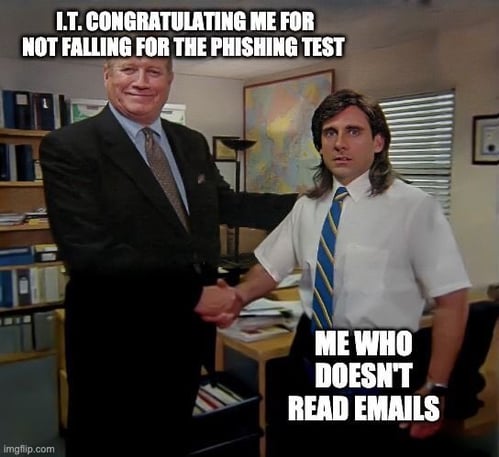
If the phishing awareness meme you included in a company-wide email didn’t get as much buzz as you’d hoped, don’t hang up your hat. After a few shots in the same direction, try a different style or a different format. Don’t get discouraged, but don’t just keep doing the same thing over and over, either.
As Steve Martin put it: “Thankfully, perseverance is a great substitute for talent.”
Nail it before you scale it 📈
First you get things going, then you scale it up. After you’ve figured out what gets a positive response from your community, turn it into a repeatable machine by standardizing these 4 things:
Topics: These are the recurring themes that you come back to. Pick the handful of things your audience has strong feelings about.
Formats: These are repeatable shapes your content takes (a first-person story, a screenshot, one specific meme layout). Condition your audience to recognize them on sight.
Voice: This is how it sounds. Pick 2 or 3 adjectives (dry, absurdist, deadpan, warm) and make sure to hit that bar every time.
Content rules: These are the always/nevers that become your fingerprint. Maybe you always use real numbers, always end on a one-liner, always include images. It doesn’t matter so much what these constraints are, except that you use them consistently. This is what makes make it recognizably you.
But remember: That’s not where you start. First, you test things out. Don’t over-engineer these elements before you’ve gotten a real, vivid response from your community. Especially with humor, you need to keep some flexibility to take advantage of spontaneous circumstances and opportunities. Once you’ve got some real bangers, you can add this structure to increase your hit rate, but don’t lock it down too fast.
Part 2: Where (and where NOT) to be funny.
Timing is everything. Companies fail on both sides of using humor too little and using it too much.
The top marketing surfaces where humor pays off 🧪
Don’t just pick your opportunities at random. Consider your audience and your objective and choose the place that makes the most sense to connect the dots. For most teams, these are the 8 marketing surfaces where I see huge opportunity.
Social media: This is the highest-leverage surface, by far. Humor works on every platform, whether it’s LinkedIn, X, Instagram, YouTube, or TikTok. Ideal because you can try so many different things so quickly. Pro tip: If your main account is too buttoned up to be really funny, create a separate, dedicated meme page.
Ads (paid and billboards): A big portion of the whole advertising industry is about figuring out humor, so this isn’t a surprise. One of my favorites recently: Exa AI created a billboard that just said “10¹⁸ > 10¹⁰⁰.” The math looks wrong, which made people curious. Turns out, it decodes to Exa > Google (exa vs. googol). Only the in-crowd gets it… and one of those people posted a picture of it, which got 22M views. (More about this example)
Email campaigns: Your inbox is a personal space, so it’s a unique opportunity to build connection with humor. Check out Derek Sivers’ “most successful email I ever wrote” to see a single message that earned thousands of new customers. Note: The subject line is the highest-stakes opportunity, since a laugh can earn (or cost you) the recipient opening the message.
404 pages: Turn a dead end into a smile, or a lead. Drift sends you a classic video of DJ Khaled lost at sea. Blizzard provides a “Rescue Murloc” - a World of Warcraft creature who will guide you back to safety. TestResults offers you a gift engraved with your name instead of an apology. And how can you not laugh at this “PICK WHO TO FIRE” option shared by Product Hunt!? (I have a deep dive on this one, in my 404 piece.)
Careers page and job posts: These are often the second most-visited page on a site, so they’re a good way to communicate your company culture - but they’re also a great opportunity to build some awareness. Perfect for a fake, rebranded, or weird job post. See: Beehiiv’s “Remote Office Manager.” Tesla’s “Master of Coin.” Apparently, Fiverr’s funny titles drove +91% page views. (More in my careers-page piece.)
Swag and merch: Bigger risk, bigger reward. Physical things are harder to produce, but are visible outside of our screens. But by including something with some humor that really resonates with people, you’ll create swag people actually want to keep. (Note: Sometimes, you can get the best of both. With a digital image of swag, people can screenshot and share even without the physical object being created.)
Stunts and campaigns (including April Fools): This is the big swing. I wouldn’t necessarily start here if you’re just figuring out what your audience wants and how they react. But a well-timed prank buys attention you can’t pay for. (April Fools is the ultimate opportunity for this - I’ve got a whole playbook for you.)
Blog and owned content: The most boring locations are your biggest opportunities. Does anyone actually read company blogs anymore? If it’s funny enough, they’ll not only read it, they’ll share it, too. I wrote a long, mostly-fictional blog post about the “history” of the socks in our swag bags (socks we don’t even sell) and how they featured in every major historical moment. People loved it. (“A brief history of Wiz socks.”)
Notice how different surfaces naturally match with different objectives: Humor on a billboard differentiates. Humor on a 404 reduces friction. Figure out what works with your goals and your audience.
Why stop there? 🥷
If you’ve figured out how to connect with your audience and what makes them laugh, think about opportunities beyond just marketing-owned surfaces:
Product: Add some joy in unexpected places. Funny features that exist purely to delight. Think of Tinder’s “Swipe Night,” Mailchimp’s high-five animation when you send, Waze’s celebrity voices, or Android’s hidden gingerbread-man Easter egg and Slack’s random App Store notes that made users anticipate updates.
Sales: Humor in cold DMs, decks, and swag. More than 70% of people say they’d buy from a humorous brand over a serious competitor. Memes in sales emails work as a personal touch, and I’ve done exactly that.
Internally: We’ve been talking about connecting with external audiences, but internal audiences matter, too. Use some humor to get your teammates and stakeholders onboard with what you’re doing! This kind of connection creates a positive, fun culture that keeps people around and makes recruiting easier. BestBuy, Southwest, and LinkedIn all list “fun” as a core value.
Where should you NOT try to be funny? ❌
This isn’t what you’re expecting. Most people think the answer is “When you have an important, serious business.” But like I said at the top: If we can figure out how to work humor into the cybersecurity industry, you can do it anywhere. But there are places where I wouldn’t recommend it.
Don’t touch sensitive subjects. Professional comedians can get away with this, but if your company makes a joke about religion or politics, you’ll get burned. Lots of social media blunders fall into this category.
Don’t punch down. If you’re a plucky upstart company, it’s fine (and even expected) to take swings at the wealthy, successful giants in your space. But if you are the larger company, it’s not a good look to make jokes at the expense of your smaller competitors.
Don’t try to be funny everywhere. If you try to force something to be funny, it’s probably not going to work. Trying to make literally every marketing surface funny in some way is trying too hard. Find the highest-potential surfaces and lock those in.
Don’t start with big swings. If you’re at a company that isn’t known for being funny, don’t start out with a massive humor-led campaign. Try it out on smaller, iterative surfaces where you can get immediate feedback. Do customers and prospects like it when you joke with them? If so, scale it up! But if not, then it’s better to learn that on a series of Instagram posts than in a Super Bowl spot.
Don’t be random. I’ll keep saying this - the whole point of humor is to connect you to people. So think about how your funny elements connect to your overall brand and how people perceive your product. I’m not saying you need to do a complete brand refresh to try out some humorous posts, but if you try some things out and it works, think about where you will and where you won’t try to bring the laughs.
Part 3: “What if I’m not naturally funny?”
Humor is a skill that you can learn, but if you’re just getting started, you may be intimidated or feel stuck.
Here’s the advice I always give marketers who want to use humor in their work, even if they don’t naturally bring the laughs: Borrow someone else’s funny.
Borrow from the professionals → Do what working comedians and top copywriters do
Tom Segura is one of the modern masters of observational humor, which is what I was describing in my first Golden Rule: say out loud what everyone else is seeing. So I’ve dug into some of the specific tips he’s shared on places like on David Perell’s How I Write podcast.
Yep, he points out that the key to his style of humor is articulating the thing that everyone else is feeling. And sure enough, he confirmed Golden Rule #2, too: “I think the simplest way to describe the best feeling of a joke is always the element of surprise.”
If you’re not sure how to get a laugh, try some of his other tips:
Have an opinion. Indifference is never funny. “This coffee is fine” will get you no reaction. “This tastes like someone boiled it in a cup” or “This is God’s gift, I want to bathe in it,” are both funny. It actually doesn’t matter which direction, but pick a side and commit.
Being a little annoyed is funny. Complaining, being bothered by something everyone else tolerates, is comedy. This is the whole Seinfeld and Larry David engine.
Build goodwill first, then you get away with more. Be likable! You can land a bold joke or comment later, if they trust you.
Say it all. Don’t let the editor arrive too early. This is probably the biggest thing holding companies back: Because having the boss in the room means most people won’t take a risk. But in order to actually be laugh-out-loud funny, you’ve got to try some things. Test more and pre-judge less.
And even more broadly, I keep this list of go-to comedy structures handy. Now that you have it, you’ll notice how often comics and ad campaigns use them.
Exaggeration: Blow one trait up so far it tips into absurd.
Wordplay: Twist a common phrase to land two meanings at once.
Dark humor: Break a small taboo to stand out (keep it benign!)
Irony: Say the opposite of what you mean to draw attention to your real claim.
Inside joke: A line only your audience will get, so they share it to feel smart.
Self-deprecation: Owning your flaws makes you sound human instead of corporate.
Paradox: Jam two opposite ideas into one line.
Deadpan: The flatter the delivery, the funnier the line.
Double entendre: Saying something with both an innocent meaning and a cheeky one at the same time.
(For the complete taxonomy, see Wikipedia’s comedic device overview.)
Borrow from your funny coworkers → Play off others ✨
You know who I’m talking about. They share the best memes on Slack and had the whole room rolling at the last team offsite. They don’t need to be part of the marketing team - if they’ve got a natural sense of humor, ask for their input and feedback on any humor-related projects.
And when you bring people together to collaborate, make sure you approach it the right way - stay flexible! By being adaptable and open to spontaneous changes, you open up the opportunity to some of the funniest moments of all.
In improv, this is called the “Yes, And” concept, where you agree and add to a person’s suggestions to create the scene. (Check out this book, all about it!) Instead of saying “No, But,” you keep things moving forward. Using improvisation is shown to increase confidence and reduce social anxiety, making it easier to connect.
Bonus points if you can use this sort of dynamic approach in interactions with your public audience, too. Which brings me to…
Borrow from your community → Crowdsource your material 🙏
This is one of my favorites. In 2023, we announced our annual Meme Battle at Wiz. We invited employees to create cybersecurity memes and asked the public to vote for the best one.
We didn’t anticipate what would happen next: A huge cybersecurity LinkedIn page (The Cyber Security Hub) with more than a million followers shared one of the memes and tagged us. We plugged an ad in the first comment and saw a major influx in followers on the same day.
Borrow from industry creators ⭐️
Who are the top content creators in your industry? Anyone who has the attention of your ideal audience is in the business of understanding what they care about. If someone nails a viral post that has everyone rolling, try to deconstruct it: What made it resonate? Why did people think it was so funny? Figure out how to make your own version.
Looking for some inspiration? Some of my favorites are:
Corporate Natalie - She says what we’re all thinking.
Elena Verna - The meme queen of growth marketing.
Renée Shaw - Are tech employees allowed to be this funny?
James Hawkins - Just go read his posts.
Jason Roeder - Probably wrote your favorite The Onion article.
Chris Bakke - The gold standard for tech satire.
Follow those people and you’ll have a constant stream of inspiration for funny marketing concepts. Plus, you can tell your boss you’re “researching” while scrolling through hilarious content. You deserve to laugh, too!
Borrow from culture 📺
Pay attention to what’s going on around you: Movies, articles, shows, tweets, and all those short-form vertical videos you watch. Notice anything that makes you laugh and try to figure out why it worked. If you’ve got a deep understanding of your target audience and what they’re expecting, you may be able to translate the premise of that viral TikTok video into something that really lands with the customers you want to be connected with.
The point is: If you don’t think you’re funny… you’re not alone. You don’t have to figure it out by yourself and you can lean on these other sources to help you figure it out.
At the end of the day: Don’t force it. There’s a huge opportunity to insert comedy into your marketing to make your audience feel seen and feel connected to your brand. If you understand them and something makes you laugh, figure out a way to bring it to them. But if you’re twisting things backwards to make it comedic, it’s destined to fail. Like “Mandatory Fun” in corporate offices, this isn’t something you can fake. So keep it real and you’ll get the laughs.
That’s it! Now make ‘em laugh.
There ya go, you did it! Humor is an elite tool for marketers and it’s only going to get more valuable in the age of AI. People are looking for human connection and making them laugh is one of the best ways to create it. Now you have the skills you need to make it happen 🎉
The core of humor? Benign violation. Shake it up, but keep them safe.
How to win in corporate humor? Be specific + Be surprising.
Just getting started? Follow these steps: Know your audience + Find common ground + Choose a goal + Start small + Keep it real, keep it simple + Keep trying. And be sure to nail it before you scale it.
Where (and where not!) to be funny? Just save the lists I shared.
Not naturally hilarious? Borrow someone else’s funny. Comedians & Copywriters, Coworkers, Community, Creators, Culture. (Wait! Those all start with C!? I didn’t actually mean to do that. But if you’re a marketer, you probably love named frameworks, so feel free to call that “Tom’s 6 Cs”!!)
You’re all set. I know it can be intimidating, but with these tools, you can do it.
And remember: Even if it’s scary, take encouragement from the fact that the bar is very low for marketing humor. Even if you’re bad… at least you’re not as bad as ChatGPT jokes 😂
See you next time,
Tom
PS - What are your favorite examples of hilarious marketing? Leave a comment or reply to this email - I’m always looking for new inspiration!
PPS - let me know if you liked this longer format of a playbook :)